

Hazardous chemicals are used throughout the University to support a variety of operations, including facilities maintenance, custodial services, agricultural activities, and other non-laboratory work environments. Although chemical use in these areas differ from research laboratories, improper handling, storage, or disposal of hazardous substances can result in chemical exposures, fires, releases, or other workplace hazards.
The Occupational Safety and Health Administration (OSHA) Hazard Communication Standard (HazCom) requires employees who work with or may be exposed to hazardous chemicals to understand the hazards associated with those chemicals and the precautions necessary to work safely. This includes recognizing chemical hazards, understanding container labels, accessing Safety Data Sheets (SDS), and following established procedures for the safe use, storage, and disposal of hazardous substances.
EHS provides Hazard Communication training for all University employees who work with hazardous chemicals or materials in non-laboratory environments. The training covers chemical hazard recognition, labeling requirements, Safety Data Sheets (SDS), and safe handling and communication practices to help employees identify and control chemical hazards in the workplace. The following guidance is a quick reference.
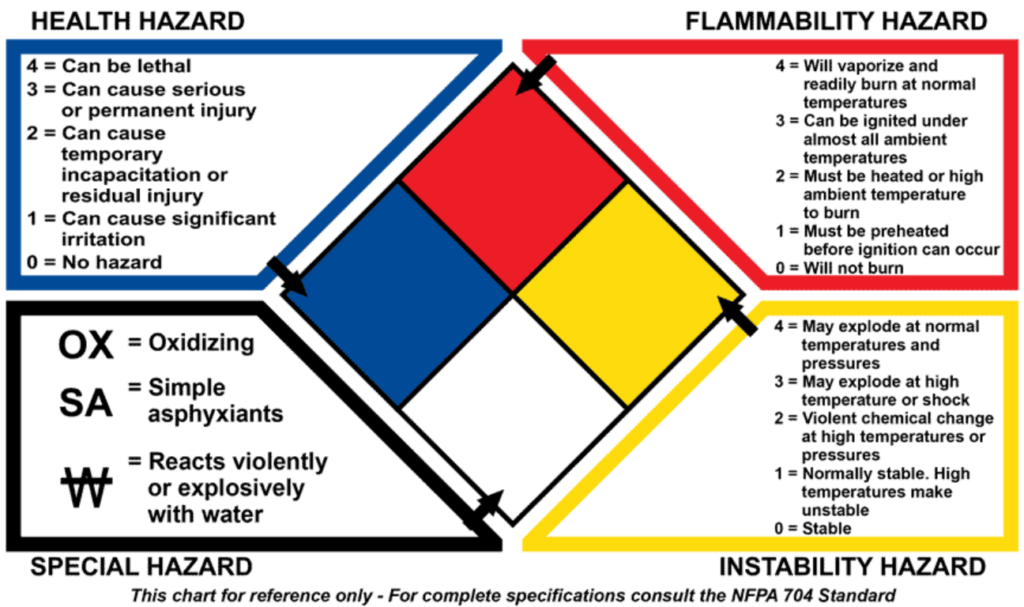
Understanding the NFPA Diamond
The National Fire Protection Association (NFPA) diamond is a hazard identification system that provides a quick visual reference of the potential hazards associated with a chemical. The rating system communicates information about health hazards, flammability, instability, and special hazards that may be important during normal handling, storage, or emergency situations.
Safety Data Sheet (SDS) Guidance
A Safety Data Sheet (SDS) provides detailed information about a chemical’s hazards, safe handling requirements, and emergency response procedures. Employees who work with hazardous chemicals should understand how to locate important information within an SDS before using a chemical. The following provides a high-level overview of SDS organization and how to find key safety information. For more detailed chemical management requirements, refer to the University Chemical Hygiene Plan.
- Sections 1–3: What is the material and what are its hazards?
- Identifies the chemical, manufacturer information, recommended uses, ingredients, and primary hazards associated with the material.
- Includes hazard classifications, label information, and chemical composition.
- Sections 4–6: What do I do if a hazardous situation occurs?
- Provides information on first-aid measures, fire response, accidental releases, and spill response procedures.
- Helps employees understand immediate actions to take during an emergency.
- Sections 7–11: How do I work with the chemical safely?
- Provides guidance on safe handling, storage, exposure controls, personal protective equipment (PPE), physical properties, and chemical stability.
- Helps employees identify precautions needed to prevent exposures and incidents.
- Sections 12–16: What additional regulatory and product information is available?
- Provides supplemental information related to environmental impacts, disposal considerations, transportation requirements, regulatory information, and SDS preparation/revision details.
Chemical Storage and Handling Practices
Proper chemical storage reduces the risk of exposures, fires, incompatible chemical reactions, and accidental releases. Chemicals should be stored according to their hazards, manufacturer recommendations, and workplace procedures.
Best practices include:
- Keep chemical containers properly labeled and closed when not in use.
- Store chemicals in their original containers whenever possible.
- Do not store chemicals on floors, near exits, or in areas where they may create a hazard.
- Separate incompatible chemicals to prevent dangerous reactions.
- Store flammable materials away from ignition sources.
- Store corrosive chemicals in appropriate locations to prevent exposure from leaks or spills.
- Avoid storing chemicals above eye level where falling containers may create a hazard.
- Inspect chemical containers regularly for damage, leaks, or deterioration.
- Dispose of unused or expired chemicals through approved University procedures.
Employees should report damaged chemical containers, chemical spills, leaks, missing labels, or other chemical handling and storage concerns to their supervisor. Unsafe chemical storage conditions, inadequate hazard communication, or other hazardous chemical concerns should be reported to EHS. Workplace incidents, chemical exposures, near misses, and safety concerns involving hazardous chemicals should also be reported to EHS. If an incident results in a workplace injury or illness, it must also be reported to Human Resources (HR) in accordance with university requirements.
