
Agribusiness, Economic Development and Value-added Agriculture
The Agribusiness, Economic Development and Value-added Agriculture program at the University of Maryland Eastern Shore (UMES) Extension focuses on a wide range of industries, including agriculture, that underpin Maryland’s economy.
The program’s goal is increasing profitability; stimulating production, distribution and consumption of goods and services; and bettering the livelihoods of Maryland residents.
Grounded in the university’s land‑grant mission, the program integrates applied research, extension education and outreach to enhance farm and agribusiness profitability, support sound decision‑making and promote economic development.
The program seeks to advance effective agribusiness management, workforce development, agricultural policy awareness and natural resource stewardship to improve livelihoods at the local, regional and state levels.
What We Do

Agribusiness
UMES Extension experts work with towns and cities, along with stakeholders to promote effective agribusiness practices, including business planning, financial management, marketing, risk management and labor relations.
Through data‑driven analysis and applied research, we assist farmers, ranchers and agricultural producers in developing sound business strategies through informed decisions.
Faculty‑led Extension efforts include targeted educational programming including statewide training for farm labor supervisors.
In addition, the program conducts applied research and education in priority areas for Maryland such as natural resource management, agricultural policy, agricultural marketing systems and commodity markets, advancing practical solutions that support rural enterprises in competitive markets.
Economic Development
Agriculture is Maryland’s largest commercial industry. It employs about 350,000 people, including nearly 6,000 full-time farmers, and contributes more than $8 billion annually to the economy, according to the Maryland Manual. Agriculture also is the largest single land-use in the state, with about 2 million acres of total land-area used for farming in 2024.
Farmers in Maryland, especially small-scale and poultry producers, face a range of economic challenges including fluctuating costs, limited market access, price volatility, labor constraints, and increasing weather and environmental risks. Many need support navigating regulations, accessing financing and identifying opportunities to vary income.
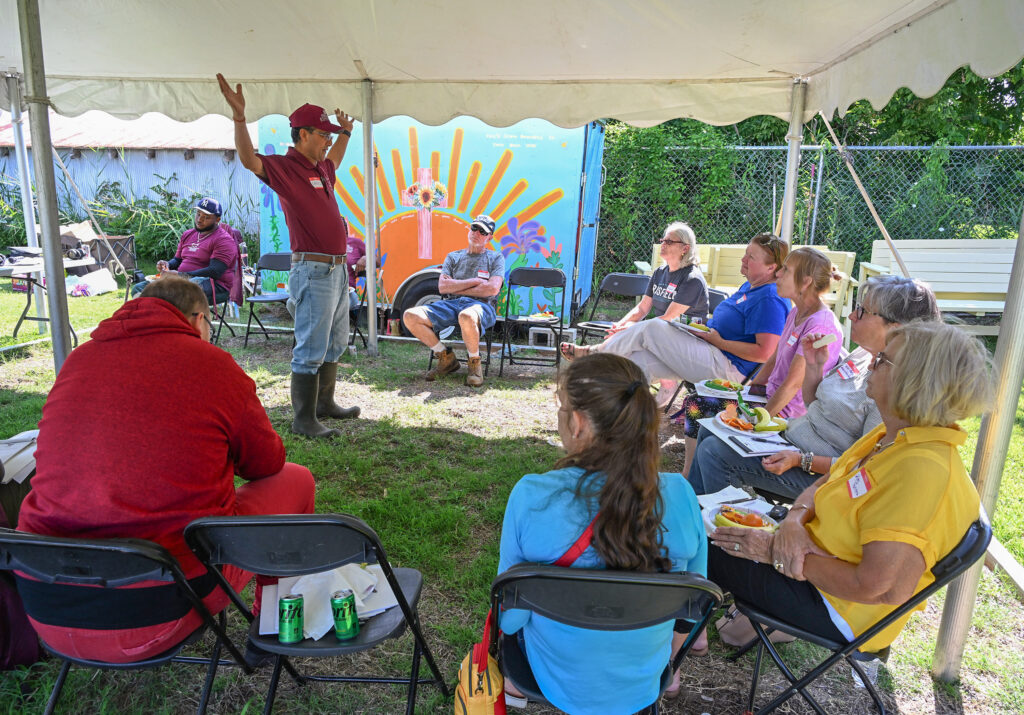
Through education, outreach and hands-on engagement, UMES Extension helps farmers:
- Identify and access new markets, including value-added and direct-to-consumer opportunities
- Improve financial planning, cost management and business strategies
- Navigate policy, regulatory and funding opportunities
- Explore growth options such as agritourism or alternative enterprises
Value-added Agriculture
In Maryland, “value-added agriculture” is defined by law as “the alteration or enhancement of a raw agricultural product, including livestock, or an agricultural service in a way that increases the product or service’s worth to a consumer and brings more revenue to a farmer, producer or processor.
This sector supports close to 74,000 jobs and delivers a total economic impact of more than $20.6 billion annually, according to a February 2020 economic analysis of Maryland’s value-added agricultural industry cited by the state’s Department of Agriculture.
Value addition involves turning crops into specialty food products such as jams, juices, etc. or niche products such as oils, tinctures or soaps.
Agritourism is a growing trend as farm operators seek ways to improve their income sources.
UMES Extension experts offer educational and networking opportunities through workshops, conferences, webinars, interactive sessions, networking, fact sheets and published guides, field demonstrations, one-on-one business mentorships, beginning farmer agribusiness coaching programs and more to get producers started on their value-addition journey.
Our Outreach Projects
Heirs’ property: As property is passed down from one family member to the next generation, some inherited properties are left without clear legal ownership. Often this is due to lacking a will, which leaves the property equally to all descendants who might not agree on selling or developing it. Dr. Lila Karki, paired with ALEI’s Nicole Cook, environmental and agricultural faculty legal specialist at UMES, are pushing for a greater understanding of the legal ins and outs of heirs’ property and what you can do to prevent ending up in this situation.
Agritourism: As small-scale farmers seek alternative revenue streams, Dr. Prem Bhandari brings evidence-based insight and with real-world examples of how interactive, on-farm activities for the public can become a value-addition for an agribusiness. From education to recreation, these opportunities have a wide range that can scale to fit your family farm. Visit the Agritourism page for more information and the interactive Maryland agritourism map.
Resources
House Elevation Resources: Somerset County, Maryland
Alley Cropping for Extreme Weather Variability: What to Know
Agritourism in Maryland: What to Know
Agritourism in Maryland: The Challenges
Contact Us

Dr. Lila B. Karki
Extension Program Evaluation Specialist
Associate Professor of Agriculture Economics
Phone: 410-651-6693
Email: lkarki@umes.edu

Dr. Nazia Arbab
Assistant Professor & Agribusiness/Resource Economist Specialist
Phone: 410-651-8353
Email: NNArbab@umes.edu

Dr. Prem Bhandari
Agritourism and Value-added Agricultural Marketing Specialist
Phone: 410-651-7974
Email: pbbhandari@umes.edu
