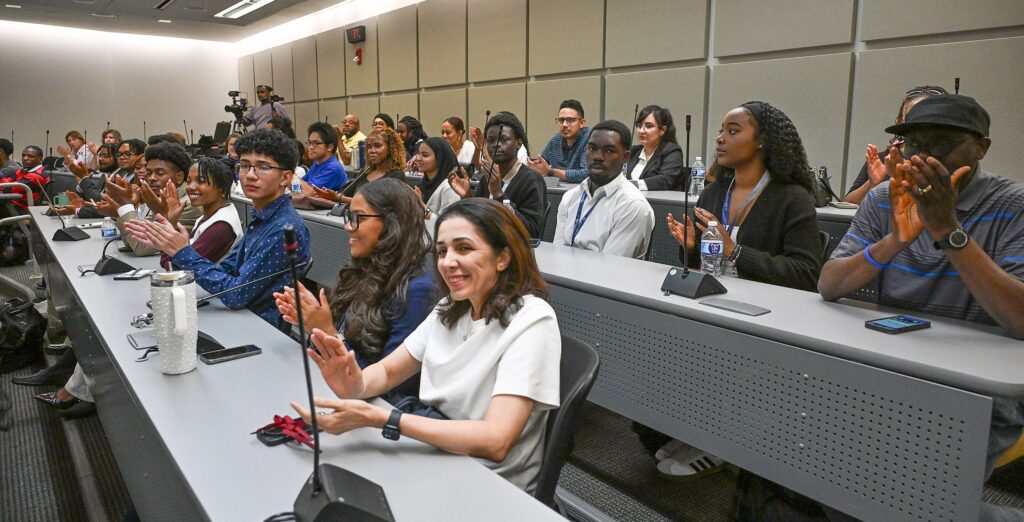
The 2026 SANS Summer Research Symposium was a landmark event. For the first time, it was led by the School of Agricultural and Natural Sciences’ Center for Student Excellence. It also encompassed all the school’s summer programs.
“I’m delighted that this symposium brings together students in research and extension across SANS to work toward filling critical careers in the sciences. It emphasizes the collaboration within the school to work across disciplines to help solve the challenges we face,” said Dr. Moses T. Kairo, SANS dean, research director for 1890 land-grant programs and administrator for UMES Extension.
Kairo congratulated the summer researchers for their perseverance over the 10-week period.
“You may have started out thinking research is about answers but discovered that it is more about asking questions, learning to think differently and working independently,” Kairo said. “Experiments don’t always cooperate; planted seeds refuse to grow or instruments give a timeframe set that doesn’t hold. The questions you ask today may spark later discovery.”
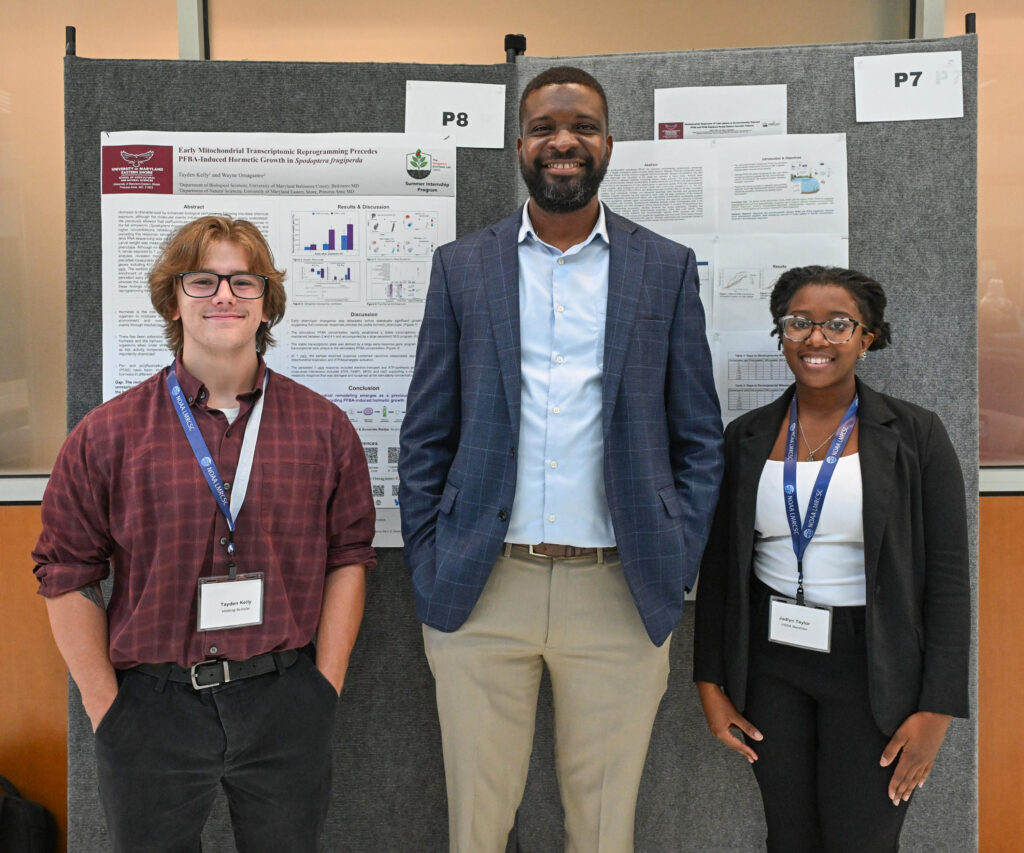
Tayden Kelly, a senior from Dagsboro, Delaware, was among the 41 UMES undergraduate students taking part in the summer program. A spring 2024 semester working on a PFAS project with mentor Euguo “Wayne” Omagamre, assistant professor of biology, fueled his interest in continued research.
“This was more in depth and very hands-on. I learned numerous lab techniques and was able to understand what it is like to be a researcher and the daily stress that comes with it. I realized the curiosity you have to have to do research,” the biological sciences major said.
Kairo emphasized that in research any unexpected result or lesson in trouble-shooting teaches creativity and perseverance.
“Real science doesn’t happen chapter by chapter. You have to constantly be changing and adapting. Research is driven by wonder and exploring the unknown. Like Captain Kirk of Star Trek fame, you have ‘to boldly go where no man has gone before.’ ”
Senior Jadlyn Taylor explored several research areas during her agriculture studies at UMES. The pre-vet student spent a semester with mentor Janak Dhakal, associate professor of animal science, studying the occurrence of Salmonella in pet food that can affect humans as well as animals. Her summer internship (Omagamre) turned to insects , looking at how environmental exposure of two PFAS chemicals (PFBA and PFOA) on mosquitoes alters their development.
“Any type of research is good to have, especially when you are working with faculty mentors and graduate students. Learning skills for the future, like lab protocol and presenting research, will stand out on a resume,” Jadlyn Taylor said.
Having extension involved in the summer internship program is in line with the school’s mission.
“It takes new minds to think and provide solutions to pressing real-life problems, for instance,” Kairo said, “this summer’s outbreaks of cyclosporiasis, Ebola, and tick- and mosquito-borne diseases.”
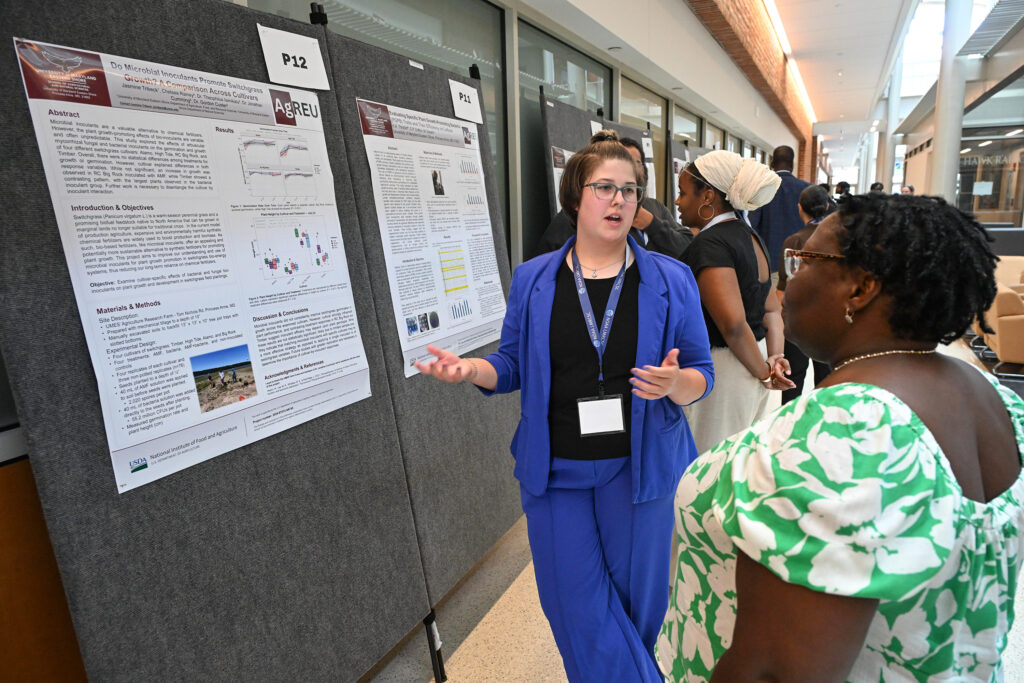
For sophomore Jasmine Tribeck (Fruitland, Maryland), the summer internship was her first research experience. Her project under the mentorship of Jonathan Cumming, chair of the Department of Natural Sciences, was “Do Microbial Inoculants Promote Switchgrass Growth? A Comparison Across Cultivars.”
“Since mine was a field experience, my takeaway was seeing the real challenges farmers may face when trying to implement switchgrass. Torrential rainfall, for example, showed decreased plant health and brought home how much the weather affects farmers,” the general agriculture major with a plant and soil science concentration said.
Being in the lab and the field is helpful in figuring out what you want to do, along with seeing the other student interns’ projects, Tribeck said.
The group included 41 undergraduate interns from programs, including USDA NextGen, STEM Students Achieving Results in Science, Research Experiences for Undergraduates in the Marine and Estuarine Sciences, Ag REU, UMES Ag Experiment Station, UMES Extension workforce development program, and the USDA NIFA’s Agriculture and Food Research Initiative Education and Workforce Development program. A group of 10 high school students participating in the UMES Extension 4-H STEM Research Internship Program also presented their research.
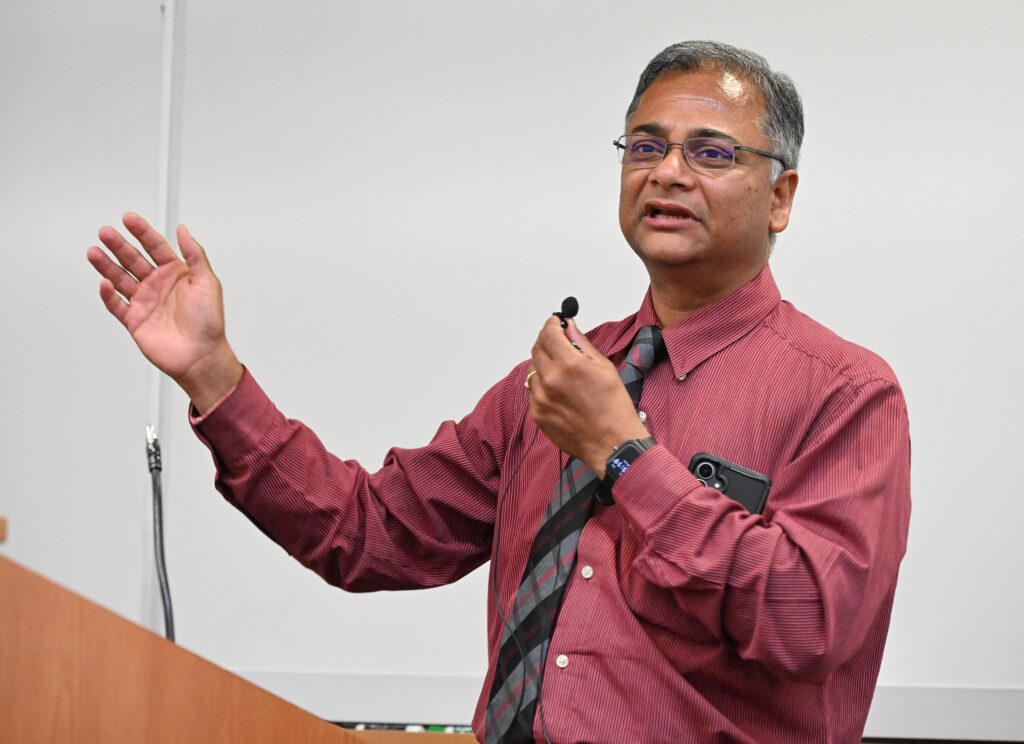
Kausik Das, physics professor and director for SANS’ Center for Student Excellence, said 34 faculty members were involved in mentoring the summer research interns.
“The diverse range of research and extension projects presented shows the depth of our faculty research. We can compete at any level, including globally,” he said addressing the interns in considering UMES for graduate studies.
Visit the Book of Abstracts here.
Watch a video here.
Gail Stephens, agricultural communications, University of Maryland Eastern Shore, School of Agricultural and Natural Sciences, UMES Extension, gcstephens@umes.edu, 410-621-3850.
Photos by Todd Dudek, agricultural communications, University of Maryland Eastern Shore, School of Agricultural and Natural Sciences, tdudek@umes.edu.
