DVM Program
Year 3
A 53-week clinical year of supervised rotations that transforms pre-clinical knowledge into practice-ready skill.
Clinical Rotation Structure
Students enter the clinical year immediately following Semester 6, beginning a 53-week clinical curriculum (44 weeks of clinical instruction) delivered as thirteen 4-week rotation blocks across Semesters 7, 8, and 9. Rotations are supervised clinical experiences that integrate everything learned during the pre-clinical years and expand students’ knowledge and hands-on skills toward becoming competent, confident veterinarians ready for a range of career paths.
A Semi-Distributed Clinical Model
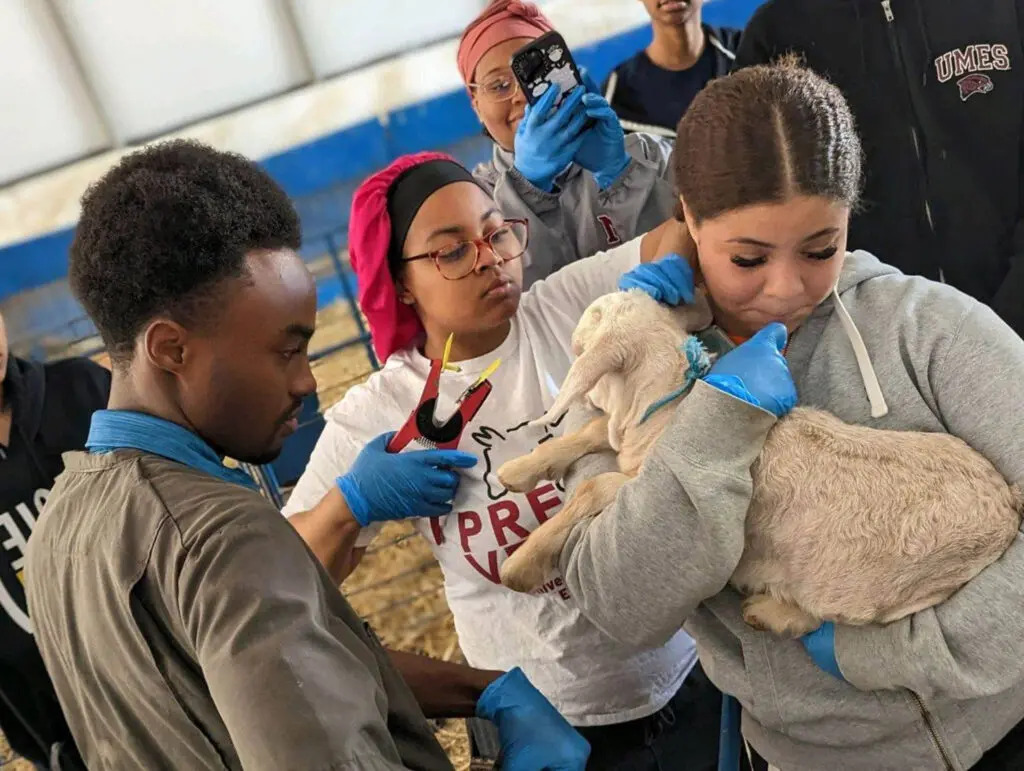
UMES SVM uses a semi-distributed clinical model: students complete required core rotations both on-campus and at a select group of screened, pre-approved off-campus clinical affiliate sites, with direct faculty oversight for all required rotations except Small Animal General Practice and Small Animal Specialty/Referral Practice, which take place at high-quality, pre-approved private and specialty practices. Elective rotations open even further, drawing on a wider network of pre-approved sites, approved research institutions, and — for up to two rotations — a site the student identifies and proposes independently as a Student-Proposed Externship.

Scheduling, Oversight & Support
Students design their clinical year schedule during the fall semester of their second year, with career advisors available through the Office of Student Affairs, and receive their finalized rotation schedule the following spring. Throughout the clinical year, the Office of Clinical Programs and Outreach (OCPO) — through Clinical Relations Veterinarians, Hub Liaisons, and UMES SVM faculty serving as Clinical Course Mentors — oversees affiliate relationships, site training, course scheduling, and rotational logistics.
Clinical Teaching & Assessment
Clinical teaching methods include individual case discussion with timely feedback, student presentations, small-group and case-based learning, clinical rounds, and scientific literature review. Students are assessed both formatively, in the moment, and summatively at the close of each rotation, through Learning Agreements, case logs, Entrustable Professional Activities (EPAs), problem-oriented medical records and SOAPs, written reflections, a capstone project, and student evaluations of clinical sites.
Because clinical responsibilities do not follow the standard academic calendar, students on rotation may have case responsibilities and evening, weekend, holiday, or emergency-duty assignments as part of real-world practice.
NAVLE & Programmatic Review
Within the clinical year, students take a dedicated 3-week window to sit the NAVLE, and the final two weeks are a required Programmatic Review course — a structured transition from veterinary student to DVM that includes exit surveys, financial literacy education, a Doctors Without Quarters (DWQ) education seminar, and other capstone activities before graduation.
Degree Requirements
See the academic and non-academic requirements every DVM student must meet.
Years 1–2
Explore the foundational curriculum that builds scientific knowledge and core clinical skills.
Curriculum
Learn how UMES SVM’s three-year, year-round curriculum prepares practice-ready veterinarians.
